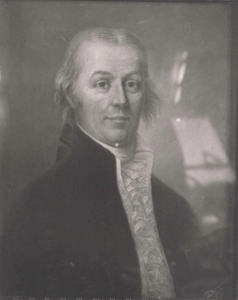
The historically valuable archives of the Museum Ladin include various documents and certificates from the early modern period. One particularly outstanding piece is the document conferring nobility from Franz Joseph I of Austria, with which Johann Baptist Rinna (1764-1846) from San Ciascian/Sankt Kassian was elevated to the nobility with the title ‘von Sarenbach’ in 1812.
Johann Baptist Rinna was a respected lawyer and civil servant who had distinguished himself in numerous positions, for example in the administration of Dalmatia after the Peace of Campoformio and later as a court counsellor in Vienna. For his achievements, he was also awarded the Knight’s Cross of the Order of Leopold in 1838 and thus became a knight.
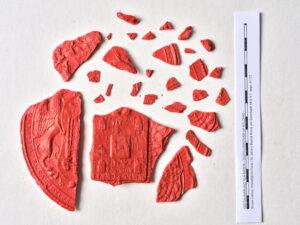
The Rinna document was discovered twenty years ago in a rubbish dump in Vienna and subsequently handed over to the Museum Ladin. The document itself is in relatively good condition, while only a collection of smaller and larger fragments of the large hanging wax seal have survived due to improper storage and mechanical damage. This seal has now undergone careful restoration.
Johann Baptist Rinna was a respected lawyer and civil servant who had distinguished himself in numerous positions, for example in the administration of Dalmatia after the Peace of Campoformio and later as a court counsellor in Vienna. For his achievements, he was also awarded the Knight’s Cross of the Order of Leopold in 1838 and thus became a knight.
The Rinna document was discovered twenty years ago in a rubbish dump in Vienna and subsequently handed over to the Ladin Museum. The document itself is in relatively good condition, while only a collection of smaller and larger fragments of the large hanging wax seal have survived due to improper storage and mechanical damage. This seal has now undergone careful restoration.
The individual fragments were joined and glued together with a special resin. Missing areas were reconstructed using a colour-coordinated wax substitute in order to restore the visual integrity of the seal. Care was taken to ensure that the additions remain recognisable as modern interventions on closer inspection.
Thanks to the restoration by Lidia Borgogno from the South Tyrolean Provincial Archives, the seal now shines again in new splendour and can therefore be presented not only as a valuable historical artefact, but also as an impressive example of the craftsmanship of past eras.
Die Pergamenturkunde bietet einen Einblick in die Adelsverleihung, eine bedeutende historische Praxis, die eng mit der politischen und sozialen Geschichte des Habsburgerreiches verknüpft ist. Das an der Urkunde angebrachte hängende Siegel stellt ein bedeutendes Symbol der kaiserlichen Autorität dar. Es verkörpert nicht nur die Macht und den Einfluss des Kaisers, sondern auch die offizielle Bestätigung und den Wert der verliehenen Auszeichnung.
The parchment document offers an insight into the conferral of nobility, an important historical practice that is closely linked to the political and social history of the Habsburg Empire. The seal attached to the document is an important symbol of imperial authority. It embodies not only the power and influence of the emperor, but also the official confirmation and value of the honour conferred.